The World’s Largest Land Arthropod Isn’t a Spider; It’s a 9-Pound Tree-Climbing Crab
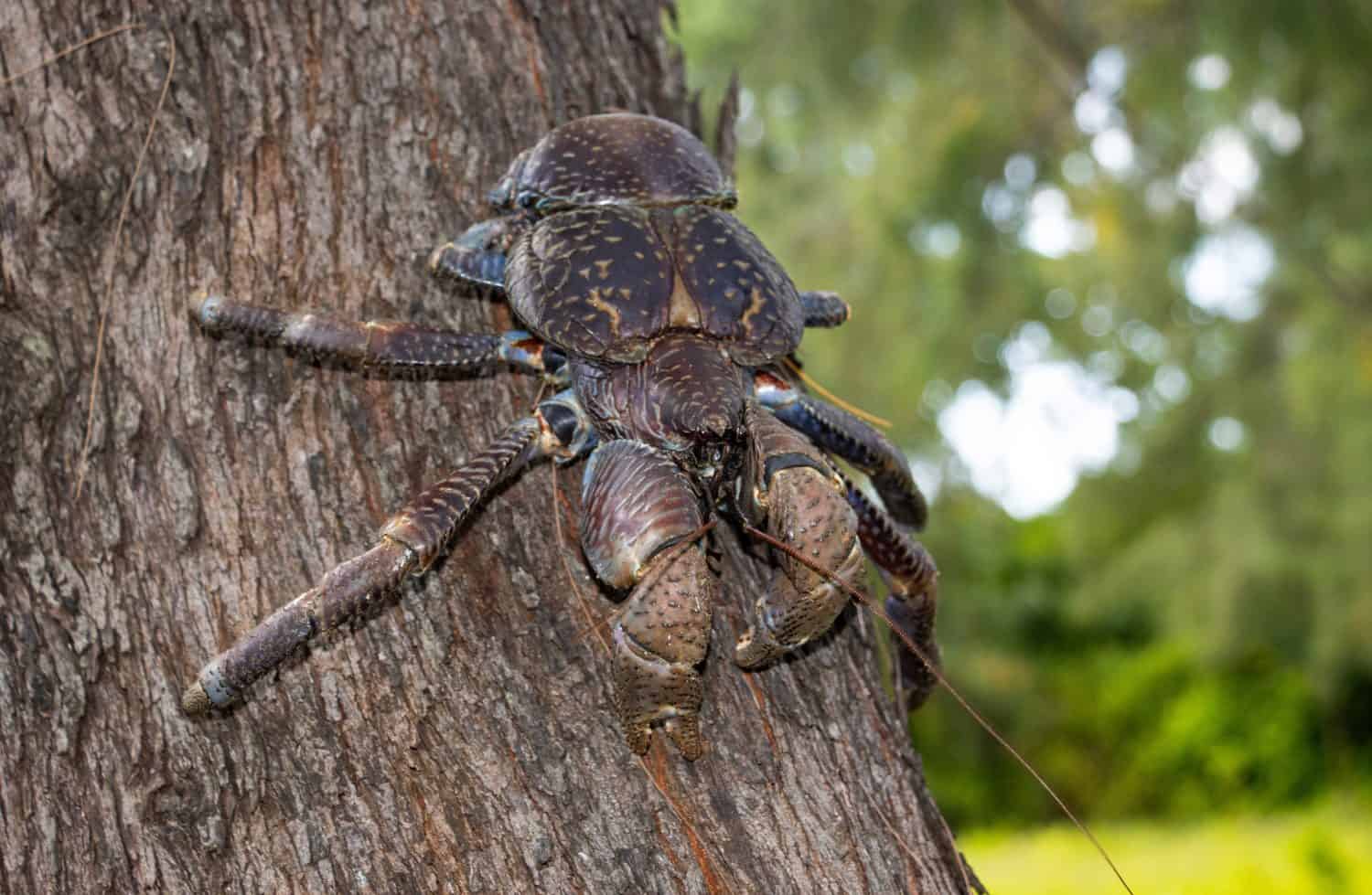
The Coconut or Robber Crab is the largest member of the hermit Crab family and are totally land based. They are large and powerful scavengers that can easily climb trees.© Nick Greaves/Shutterstock.com (© Nick Greaves/Shutterstock.com)
Imagine walking through a tropical forest and spotting something climbing up a tree. You get closer and think, “Is that a crab?” If this has ever happened to you, then chances are that you were looking at a tree-climbing crab of the same species as the one in this crazy Instagram reel. Known as the coconut crab, this creature is one of the most unusual crustaceans on Earth.
Where Does This Tree-Climbing Crab Live?
Coconut crabs (Birgus latro) inhabit tropical islands throughout the Indian and Pacific Oceans. Their range stretches from islands near the eastern coast of Africa to French Polynesia in the Pacific. They also occur in parts of Indonesia, the Philippines, and other island regions.
Coconut Crab (Birgus latro). IUCN status: Vulnerable.
Weight: 2.2–9 lb (1–4.1 kg)
Length: 0.7–1.3 ft (0.2–0.4 m)
See the full Coconut Crab profile
Unlike many other crab species, coconut crabs spend almost their entire adult lives on land. They typically shelter in burrows or rock crevices during the day and emerge at night to search for food. Adult coconut crabs cannot swim. Although they are crustaceans and begin their lives in the ocean, adult coconut crabs are adapted to breathing air.
However, the ocean still plays an essential role in their reproduction. Female coconut crabs carry fertilized eggs and eventually come to the shore to release their offspring into the seawater. The young spend their earliest stages floating in the ocean before eventually settling near land. During their early lives, they resemble traditional hermit crabs and protect their soft abdomens using empty shells. As they grow, their bodies develop hard protective coverings, allowing them to abandon their borrowed shells and live permanently on land.
How Big Can Coconut Crabs Get?
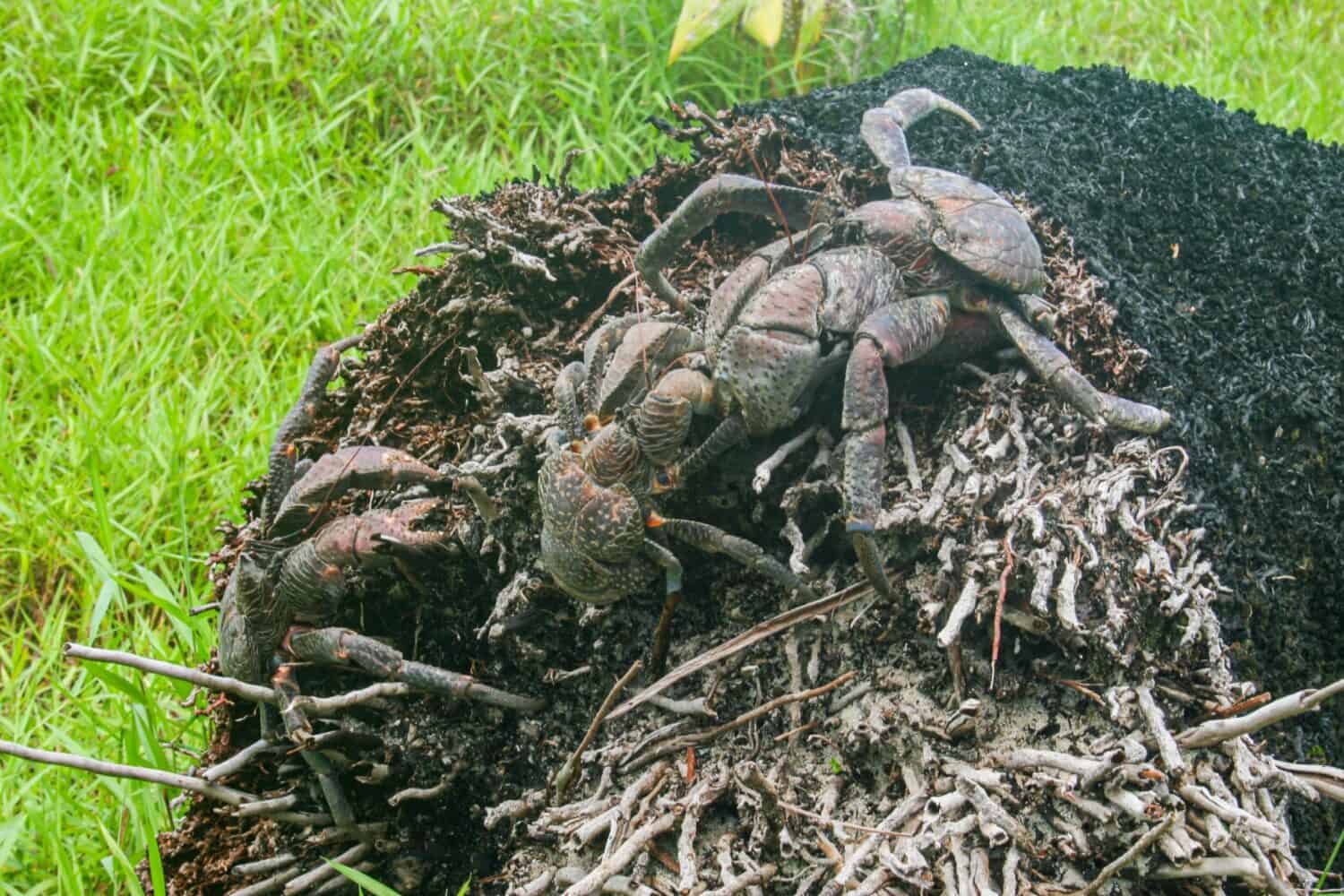
The coconut crab is part of the anthropoid family, which also includes spiders and insects.©Afriadie/Shutterstock.com
Coconut crabs hold the title of the world’s largest living land-dwelling arthropods, a group that includes insects, spiders, and crustaceans. The largest well-documented individuals can weigh approximately nine pounds. Their legs can stretch nearly three feet from tip to tip, making them considerably larger than most other crabs.
Largest well-documented coconut crabs: 9 lb (4.1 kg)
Typical Coconut Crab: 5.5 lb (2.5 kg), range 2.2–9 lb (1–4.1 kg)
Adult human: 176 lb (80 kg)
About 5% as heavy as one adult human.
Bars drawn to scale. The thin line spans the weight range for Coconut Crab.
Sources:Largest well-documented coconut crabs: A-Z Animals: "The World’s Largest Land Arthropod Isn’t a Spider; It's a 9-Pound Tree-Climbing Crab".Typical Coconut Crab: A-Z Animals profile.Adult human: Height and weight: rounded typical adult; CDC/NCHS, Anthropometric Reference Data for Children and Adults: United States, 2015-2018, Vital and Health Statistics Series 3, No. 46 (cdc.gov).
Their enormous claws are especially impressive. Researchers estimate that the largest coconut crabs can produce pinching forces of about 3,300 newtons. That’s enough strength to break into tough food sources, making their claws particularly dangerous to anything caught between them.
Why Do Coconut Crabs Climb Trees?
You may be wondering why a tree-climbing crab would ever exist in the first place. But these crabs climb trees for several reasons.
Food is one important reason. Coconut crabs climb trees to access fruit and other edible materials that might be unavailable on the forest floor. Climbing can also help them escape threats or reach sheltered areas. Their remarkable climbing abilities also help them navigate their island habitats.
And yes, coconut crabs actually do eat coconuts. They use their powerful claws to tear away sections of a coconut’s fibrous husk. Once they expose the inner shell, they work at one of the softer openings until they can reach the flesh inside.
That’s not all they eat, though. This tree-climbing crab is an omnivore, meaning it consumes both plants and animals. The rest of its diet often includes fallen fruits, nuts, seeds, leaves, dead animals, and other crustaceans. They may also eat insects, small vertebrates, and occasionally other coconut crabs.
How Long Do Coconut Crabs Live?
Unlike many smaller crustaceans, coconut crabs grow slowly and may live for several decades. Some estimates suggest they can live up to about 60 years.
Even though they live a long time, the population is not robust. The International Union for Conservation of Nature (IUCN) classifies coconut crabs as Vulnerable, meaning they face a high risk of extinction in the wild. Habitat destruction, introduced animals, and growing human development typically threaten populations.
IUCN Red List status for Coconut Crab: Vulnerable. Population trend: Decreasing.
Their slow growth and delayed reproduction make it difficult for depleted populations to recover quickly. Conservation efforts include protecting habitats, regulating harvesting, and monitoring crab populations to understand their needs better.
An Extraordinary Crab
The tree-climbing crab that invaded Instagram is truly incredible and looks like something out of a science fiction book. Though they begin life in the ocean, these crabs eventually become completely terrestrial. They can break into coconuts, hunt other animals, and survive for decades in tropical forests.
The next time you visit a tropical South Pacific island filled with swaying palm trees and sandy beaches, remember that an enormous nine-pound crab might be climbing through the branches overhead.
Source: Nature



0 Comments